



|
Getting your Trinity Audio player ready...
|
By Abdullahi Irshat
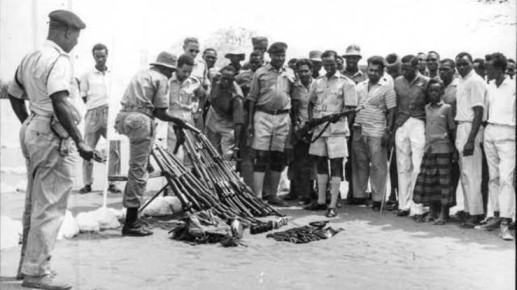
This is the story of northern Kenya in the 1960s, then known as the Northern Frontier District (NFD), and the brutal Buna Massacre of 16 February 1964. It begins by exploring the origins of the Shifta War—known to some as the Northern Frontier District (NFD) liberation struggle—tracing the historical, political, and social forces that gave rise to the conflict.
In 1963 at the height of Kenya’s independence, as country-wide celebration picked up, oblivious, a band of Pan-Somali secessionist leaders rallied the people from the Northern Frontier Districts (NfD) of Kenya to secede from the newly independent Kenya to Somalia.
They waged the NFD Liberation secessionist war, a five-year conflict that lasted from 1963 to 1967. Officially, the Kenyan government remembers this period as the Kenya Emergency, commonly referred to as the Shifta War. For the people of the region, however, it is remembered as “John Ca’arar,” loosely translated as “the time people ran away from John.” “John” was a reference to Jomo Kenyatta, Kenya’s first president, under whose administration the Kenyan Army launched a relentless counterinsurgency campaign against the Shifta insurgents.
The name “John Ca’arar,” captures not only the fear and flight that gripped the region but also the mass displacement and suffering endured by civilians caught in the conflict.
The local Somali, Borana, and other communities affected by the conflict have long resented the term “Shifta,” a label used by the Kenyan government and inherited from the British colonial administration. They regard the term as derogatory and demeaning. Literally meaning “bandit” or “thug,” Shifta implied criminality rather than political resistance.
Yet many people in the Northern Frontier District (NFD) viewed the conflict as a liberation struggle—a fight for self-determination and union with Somalia, rather than an act of banditry. To them, the movement was a response to what they perceived as political marginalization and domination by the newly independent Kenyan state, whose leadership they believed did not adequately represent or protect the predominantly Cushitic communities of northern Kenya.
According to Sadik, who served in the liberation struggle said, “we perceived the government did not represent us and our believe was that it was dominated by Bantu political elites and soldiers unresponsive to the aspirations of the predominantly Cushitic peoples of northern Kenya.”
At the beginning, the NFD liberation movement enjoyed widespread popularity and support from the local communities. However, this support gradually waned in the later years as Somalia’s military assistance to the insurgents proved misguided and ineffective, allowing the Kenyan Army to gain the upper hand over the rebel fighters. The war lasted for five years and formally ended with the signing of the Arusha Declaration, but it left behind a lasting trail of tears.
The local Somali, Borana, and other northern communities affected by the conflict have long resented the term “Shifta,” a label used by the Kenyan government and inherited from the British colonial administration. They regard the term as derogatory and demeaning. Literally meaning “bandit” or “thug,” Shifta implied criminality rather than political resistance. Yet many people in the Northern Frontier District (NFD) viewed the conflict as a liberation struggle—a fight for self-determination and union with Somalia, rather than an act of banditry.
To them, the movement was a response to what they perceived as political marginalization and domination by the newly independent Kenyan state, whose leadership they believed did not adequately represent or protect the predominantly Cushitic communities of northern Kenya. “… And old man who asked to remain anonymous put it bluntly, “they the government is dominated by Bantu political elites and unresponsive to the aspirations of the predominantly Cushitic peoples of northern Kenya.”
In Wajir, the epicenter of the budding secessionist movement, the airwaves were filled with stirring freedom songs broadcast from Radio Mogadishu. Laced with patriotic melodies and rallying cries that urged the people of the former NFD to join the liberation struggle, the broadcasts captivated many young men, who flocked to enlist in the NFD Liberation Movement.
With Somali propaganda broadcasting patriotic, war-inspired songs over Radio Mogadishu, many people in the former NFD were captivated by these emotionally charged anthems performed by celebrated Somali artists such as Hibo Nuura, the late Fatuma Qaasim Hilowle, and Fatuma Hirad. Among the most influential was the freedom song, “Reer Wajeeroow, hoo calanka… hoo,” which reverberated across Wajir, becoming a powerful tool for recruiting the region’s youth into the bloody secessionist movement.
One of the verses repeatedly aired on Radio Mogadishu proclaimed:
“Reer Wajeeroow, hoo calanka… hoo… calanka.Hog ayaa idiin daboolan; ka soo hoyda hororka iyo waraabaha ee hooda calanka.”
English translation:
“O people of Wajir, behold the flag… hold fast to the flag. A grave awaits you if you do not. Come out from the shelter of fear and the hyenas; gather beneath the flag of freedom.”
As the war raged across every corner of the NFD, ravaging homesteads, destroying livelihoods, and shattering traditional ways of life under a hail of bullets, bombs, and bloodshed, time itself seemed to stand still. The Borana aptly describe this dark period as “Gaf Daba”—the time when “the clock stopped ticking.”
Sadik Hassan, alias “Caaga-Caade,” now in his eighties, vividly recalls the turbulent years of the 1960s. Barely twenty years old at the time, he joined the NFD Liberation Movement alongside five of his relatives.
With a tinge of nostalgia, he recalled, “I joined the movement with Arra-Guub,” meaning “the earth-scorcher,” a nickname that symbolized his fierceness and bravery.
“We were fighting for our freedom and our dignity because we did not believe the Black Bantu Kenyan soldiers would treat us fairly.”
He added that there was a deep-seated fear that the Kenyan soldiers would rape their women and discriminate against the Somali people.
But for Abdi Boru of Garbatula, now in his eighties, the memories of that period are equally distressing. Like Sadik, he recalls those years with deep dread, describing them as “very bad, very bad.” His condemnation of the so-called movement is more forceful and blunter: “Starting the ‘Shifta’ was foolish and regrettable,” he said. “It was stupid of us to be misled by Somalia. Indeed, we were totally foolish.”
As the brutality and devastation of the war gradually subsided toward the end of the 1960s, the initial community support for the conflict also began to wane.
It was during these early years of the NFD liberation struggle that insecurity in the region claimed lives in Buna and led to the loss of thousands of livestock.
In 1964, Buna was among the towns that slipped into an unsettling silence. The Buna massacre was already in the making. It began when the great-grandson of the legendary Ajuran leader Boqor Idow Roble, Maalim Adan Hussein Idow—then a chief in Buna—vacated his position and joined the much-hyped NFD liberation movement in Somalia. He left with a large number of relatives and prominent Ajuran leaders. As confusion spread, many parents withdrew their children from school, causing enrollment to drop sharply.
A meeting convened by the then Wajir District Commissioner, Mr. Judge, at Buna Police Station in February 1964 to discuss his replacement turned tragic. Unbeknownst to many, the area near the police station—where the DC was staying—was bordered by a seasonal stream and dense vegetation, which provided cover for an ambush.
DC Judge and Inspector Khalif were at the police station preparing for a community engagement the following day. As fate would have it, the DC was killed, but Chief Khalif survived the assassination attempt and escaped unhurt. Upon returning to Wajir, the government reportedly deployed a contingent of the General Service Unit (GSU), a feared paramilitary police force, which descended on the town and carried out reprisals. Houses were burned, women were allegedly raped, and 59 residents were killed in what is described as collective punishment. Others were shot, while some were thrown into wells in Buna as they watered their livestock.
The violence particularly targeted herders at the Buna wells. Hundreds of cattle were confiscated as “blood compensation” for the killing of the District Commissioner—reportedly calculated at four times the usual rate of 100 head of cattle or camels. As a result, many Ajuran families were widowed, orphaned, and deprived of their livelihoods, a condition of poverty and destitution that, for some, persists to this day.
Following the confiscation of livestock, a confrontation erupted at Turantura, about 15 miles from Wajir. A group of NFD liberation fighters, led by a Degodia commander, Ali Hirsi, alongside an Ajuran fighter from the Charoto family known as Huulufo, attempted to recover the seized animals. In the ensuing clash, Ali Hirsi was killed while fighting fiercely. Many from both the Ajuran and Degodia communities remember him as a brave fighter, according to Osman Adan Osman.
He adds that the older generation remembers the late Ali Hirsi as one of the bravest fighters of his time, while the Ajuran also regard Huulufo as a hero. One of the earnest earliest poems attributed to the bravery Ali Hirsi and as a rallying recruitment red:
“Dorki as Cali Xirsii dhalay iyo Cantob baya galay digal o Daud aya bixi dab culus”……. this is translated as the brave Ali Hirsi have joined the liberation and Daud (General Daud) gave out heavy weapons”
As events in Buna unfolded on 16 February 1964, similar violence was occurring elsewhere. At Af’ad and Mansa in Wajir East, NFD liberation fighters engaged the Kenyan army. Dozens of fighters were killed as government forces prevailed in what is remembered as the Battle of Af’ad. Across the entire northeastern region—from Garissa to Mandera—the Shifta War and its excesses engulfed communities in widespread violence.
Fatuma Guracha, a thoughtful woman with a quiet demeanor whom I met in the summer of 1995 in Eastleigh, recounted these events to me. She is remembered as the only women who joined the NFD liberation struggle.
When I asked her what motivated her to join the struggle, she said she wanted to avenge the rape of her best friend by the army at Buna. Our conversation further revealed the deep trauma, destruction, and suffering caused by sexual violence against women and girls during the war. With tears in her eyes, she added that she decided to join the NFD liberation after her best friend was raped by soldiers.
The story of Fatuma Guracha, is reminiscent of the Indian Bandit Queen referred to as Phoolan Devis who survived kidnapping and violent gang raped, and then she led a notorious gang of dacoits, bandits committed to retaliate the crimes of gang rape against her.
This article would not have been possible without the invaluable contributions of the late Abdi Osman Abdalla and the late Fatuma Guracha, who in 1995 first introduced me to the history of the Buna massacre. I am also deeply grateful to Ibrahim Hussein (Ibrahim Seer), the former Wajir West MP, for helping me understand the complexity of the massacre and its casualties. My sincere thanks also go to my elder, Mzee Abdullahi Maalim Adan, a survivor of the massacre, and my friend Osman Adan Osman, former Headmaster of Sabunley Secondary School, whose insights and historical knowledge greatly enriched this work and motivated me to document the forgotten history of the Buna massacre.

