

|
Getting your Trinity Audio player ready...
|
SPECIAL song dedicated to HABASWEIN (the place of milk and honey
By Abdullahi Irshat
AT THE BEGINNING, I was excited and enthusiastic. But some of my friends would dissuade me from going there. Clasping their hands on their head, they would say to me: “Ooh Gosh, my gosh! you mean you have been posted to Haa-bar-wein?”…. With a feeling of not knowing what to expect….on a one Friday morning, I bet the perilous road to Habaswein with the only nep expressive bus owned by one from Isiolo, Warsame….the Warsame Express. With my few belongings: a “banko” bed and few cooking cutleries, on I byed the Wajeer township. On arrival, I was supported by others to my quarter. Contrary, to the unpopular stereo-type echoed thousand times, I found the place and the people affable. Dressed in cultural white cloths and shoulder shawls with Somali knives belted to their thin-waist. The men were light-creamy dark, and chocolate colored and unisomely handsome.
The women were profoundly polite and beautiful, looking like angelic from distant heavens. And they would address me, as “Walaal” meaning my brother. I found this hilarious. I found this heavenly appealing in a good way. Largely, brought up in the larger Wajeer and in the interior “Fai-land”, I was unaccustomed to this side of Wajir south salutation. Often, we used “waa-lo’ow” or “eebow” as our preferred salutation. I was largely unaccustomed to this “walaal” but this would later become more of a daily ritual for me. And with each time this was pronounced to me, I felt at home, and among my kins: my brothers and sisters. For me, “walaal”, meant lovingly hypnotizing. Indeed, I felt this was my first Habaswein “Damascus Moment”.
Often mothers trudging little one’s by the thin wrist would come to the dispensary and call me “walaal” all day long: young beautiful women with soft voices that pierced….the roof ceiling….. In much of the Somali culture especially in my time, and generation, we were brought up to culturally acknowledge that “every Somali woman is your sister”… mother, cousin or niece”. And that, here I was being called, “walaal” by beautiful and great Somali sisters. This was heavenly inviting.
But as though this was not enough, some community members would bring me calabash of milk and bottles of cattle ghee. The hospitality was plenty and endless.
As I reflect on the great years now, I feel a yearning happiness. To those others who splashed cold water on my feet and initially discouraged me to coming to Habaswein in a typical stereotype; I say “shame on you”…. And as the old rustic cliche goes, “never judge a book by its cover” as Habaswein would turnout to be one of the heavenly place.
At the time, there was also the other side of Habaswein: the political sphere was shimmering underneath. Habaswein was under the strong grip of the late Mzee Abdi Ogle and by-and-large the MZ. They enjoyed immense political privileged and power that nearly was the envy of the time. Call it the MZ or the Ogle dynasty: they wielded and controlled immense influence and power….they were proud lots but socially accepting or accommodating if you only acknowledged their leadership and not challenged. The snr Ogle reign lasted years. But for others, this period was uninvitingly a period dominance and painstakingly autocratic rule. And largely, the resilience of the MK’s was testing, often they appeared to be in the opposition, and maneuvering for social political space. I liked their vigor and quest for political accommodation that appeared distant at the time but would gladly come much later with organized onslaught, and political regrouping. I would often observe the relationship of these siblings, (MZ’s and MK’s): to say the least, a little frosty. Never-the-less, healthily competing and in spite of the up-hill endeavors for the MKs they relentlessly faced, off, [they] stealthily regrouped as some kind of freedom fighters. They struggled to unravelling the political grip that disfavored them and others.
Fortunately, or unfortunately, while the status of the past history of any society’s or group’s use or misuse of their dynamic’s of power and the dynamics and divides will always be tested and/or associated, or remembered differently and/or interpreted and analyzed differently; or acknowledged differently by different people: whatever, it is in my humble assessment that the late Abdi Ogle was a strong-willed old rule, a charismatic leader who rallied his followers to a path of peace with authority albeit autocratic. Whether you liked him or not, he was a leader of his era. Obviously, others would resented his leadership’s and tha he controlled who came in to Habaswein and who went out and most times as mandated by the colonials. He would sometimes deport antagonists to his rule especially the “Galtiis” from Ethiopia and trouble-rouser from Somalia. He maintained the peace of Habaswein through strength, and defying wits. He was bright and proud. He often said, “kuwan waa in-an-han-kolka iskiga kabana”; we have to keep the trouble maker at arms length, he often reiteriated. That’s how those he saw it deemed rebellious were kept at bay. Those who challenged his leadership, he dealt them a heavy blow, exile them to Somalia or Ethiopia especially the MZ from Som.
The MK on the other hand were cautiously courteous. They were patient and thoughtful but also strategic in their opposition to ruler that disfavored them. And agreeable they were. An old uncle-like of mine from this family at the time was the late Mzee Maalim Hassan popularly known as “fanya-fanya”. The father of my old schoolmate. The Mzee would genously use all antics, craft and intuitions to advocate for equitable social political space, not only for the MKs but also for other Habasweinians.
It was around this tense political climate that I met, greeted and treated the late Mzee Abdi Ogle, an affable, a petite framed and radiantly jovial old man in his 80s. He was charismatic, friendly and engaging. He dressed in tradition Somali white shoals. He wore a big-bladed Somali “Bilaba abley” knife wrapped around his thin waist. And here, he appeared the indisputable king of MZ, the great sultan. He was typically dark chocolate colored, a more cream-like amber colored. And with a mildly trimmed beard, he was greatly handsome and admirably appealing. For me, meeting him was like glaring at the making of history, a deeply personal. Treating him and sharing a light jokes and laughter was healing. it was my other Damascus moment” at Habaswein.
By-and-large, Wajir South is a largely a politically charged place where politicians hardly survive elected parliamentarians seat more than once. But this place has a sanely serene, a swath of beautiful landscape with unique topography: a vast Waso plain that stretched far to the distant horizon the eye can see or not see. It is one of the largest constituencies in Wajir. Unfortunately, each border demarcations they have been left out to get the constituency division. It’s a constituency that is one fold or two-folds the size of some of the other Wajir constituencies. And that, the town of Habaswein, has always remained the pulsating heart of of Wajir South. It’s centrality links to others, stations and across the Wajir County from Sabuli to Sarif is like a biblical cord. And like Texas in the States, Wajir South is known as the cattle country of Wajir: a town that is impressively popular and with a vast expanses of land and a favorable climate for grazing during the rainy seasons.
During these seasons, the plains provide abundant nourishment for the proud herders and their large cattle roam large the swath of Waso-land. Watching cattle-herders whistling their ways and herd of cattle around, enjoying the bliss of natures plenty is heavenly. The herders whistle and sing in praise of their beautiful cattle as they shepard across the plains and as though in acknowledgement, the cattle beautifully chorus of mooing as they majestically splash their long tails by sides, and the calves bleating cries adding to the mix of the moment is a sight to reknow: the capturing greenish scenery rolling over the plains, providing proud herders an opportune tending to their wares, and cattle, a bliss made is a great sight.
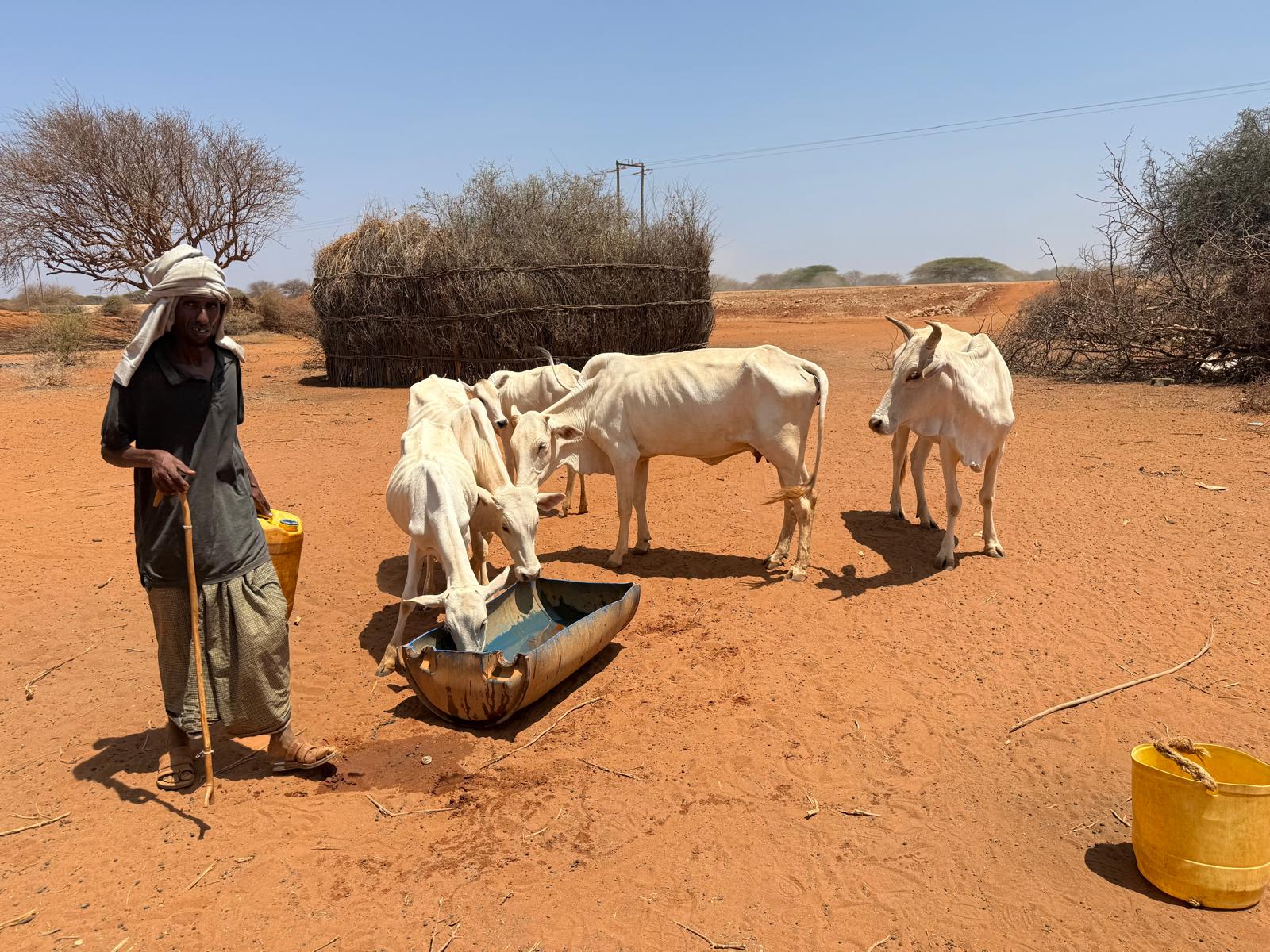
Sadly, in the drier spells, the story is different, a withering heat that burns the very air reigns large. The blistering and blinding reflection of sun rays shimmered across the land. The swirls of whirlwind is thump sore. And thus the source of the name Ha-bas-wein, which denotes the “whirlwind wind”, is often a frequent reminiscent of the dry spells, that encapsulate the plains.
That aside, there was also the dark side of Habaswein: the place suffered acute water crisis during my stint till about a decade ago. Often, women and mothers and girls would come to me at the dispensary seeking help with water to prepare food for their families. It was a very difficult time, unbelievably those who know Habaswein then can attest to this malaise and the stark difference of Habaswein today. The of lack of water of the past vs the plenty of water now. What a gracious God’s gift is a blessing everyone should be thankful. I recall when mothers and girls came to me, it was difficult for me to deny them the precious water…..:: it would have been abominable.
Often, girls and women would seek water from the police who would jest them, and meanly degraded them…. and I would resent their treatment of our “beautiful gernuks” in such a way. And thereafter, when mother’s and girls would come and tell me, “wakaal” we lack water to cook food with for our children”. And we want you to give us a bucket of water…. just one or half a bucket. This had an extreme toll of me. At one point, I had to empty the dispensary water tanks and the the chief, the late chief Sirat Sh. Farah would ask me with a serious note: how and why and what happened that you finished the water tanks? And I would simply shrug my shoulders and tell him in plain voice: “I gave the water to thirsty mothers who called on me calling me ‘waalal’ and they were thirsty-mothers and I gave them the water.”
The late chief Sirat was one of the most gracious old man. He would look at me with a serious but cautiously stoic face and still…. say nothing but at the end, he would leave in huff……he was often soft spoken, brisk walker. And the next thing I knew was that he would bring me drums of waters with the DOs rover for the dispensary use. I will always be grateful to the late chief for his support: he was a fatherly-like to me; a gently polite, a soft spoke, a fatherly like to me. He would have reprimanded me, but instead he never did. He treated me as one of his.
Writing about Habaswein gives me a sense of Déjà vu but above all a sense of love for the place and the people of Habaswein.
And as I reflect on Habaswein forty-five years on, I feel my experience of the place as one of the most enriching and I still feel, the nineteen-seventy-8 as yesterday-year. And with that: I will leave you to enjoy with this piece; song on Habaswein.
Originally published in Wajir Diaries
