



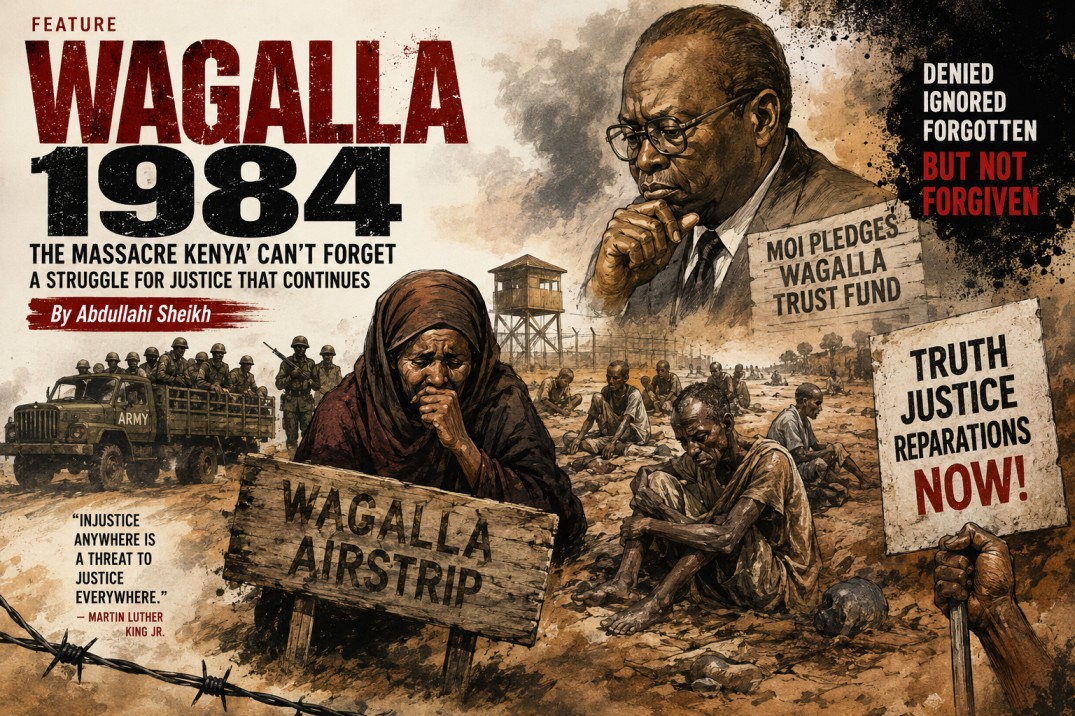
By Abdullahi Sheikh
In the remote reaches of northeastern Kenya, Wajir has known every nuance of cruelty, but never on the scale of the 1984 Wagalla Massacre.
On February 10, 1984, the residents of Wajir woke up to face a new day. It was a sunny Friday morning when more than five thousand civilians from one Somali clan, the Degodia, were targeted in a dubious military operation. They were rounded up from their homes, mosques, marketplaces, workplaces, and grazing fields and ferried in Kenya Army lorries to their deaths at the desolate and disused Wagalla Airstrip in an operation reminiscent of the Holocaust.
At the end of the four-day ordeal at Wagalla Airstrip, thousands were dead from torture, starvation, and being burned alive, leaving families permanently bereaved.
It remains the single largest mass killing in Kenya’s history and was carried out by the Kenyan Army and government with a chilling professionalism. The massacre has often been compared to the killing of Bosnian Muslims during the Srebrenica massacre, the largest mass murder in Europe since World War II, in which more than 7,000 Bosnian Muslims were killed by Bosnian Serb forces. As in Wagalla, victims were stripped naked, starved, and subjected to inhumane treatment.
Hassan Gure, a survivor of Wagalla, remains bitter and unforgiving.
“Without justice,” he says in a low, measured tone, “Wagalla walks in the shadow of Rwanda, even fifty years later.”
Abdi Abdullahi, whose father, then in his seventies, was picked up while on his way to the early morning Fajr prayer and herded to Wagalla, shares Hassan’s anguish.
“They burned, tortured, and killed my father and dumped his body at Della, 50 miles west of Wajir town,” he says in a low, whispery voice.
Fighting back tears, Abdi says he has never understood how a country’s armed forces, in a civilized world, could descend into such primitive violence as to kill thousands in the most barbaric manner—starving them for days and burning some of them alive.
Questioning the rights of the dead, he poses a haunting question:
“To whom does a dead body belong? They [the army] refused me permission to retrieve and bury my father after his body was dumped at Della. It took me seven days of searching through the bush to find and recover my father’s remains.”
For many survivors of the 1984 Wagalla Massacre—orphans, widows, and the bereaved—the word W-a-g-a-l-l-a evokes profound sorrow, anger, and betrayal. The challenges facing affected families have their roots in a culture of denial for which Kenya has long been criticized.
On the eve of the multiparty elections in 1992, former President Daniel arap Moi, during a visit to Wajir, promised to establish a Wagalla Trust Fund to compensate the victims.
Those who attended the rally recall the former president sitting through speeches extolling his development record in the region and captivating the crowd with his trademark charisma as he sought votes during the campaign season. The promised trust fund has never materialized.
It is also widely believed that some individuals entrusted with steering the proposed fund were later rewarded with prestigious positions in the Moi administration, including cabinet posts and senior civil service appointments.
A university student group operating under the banner of Truth Be Told (TBT) has since championed the Wagalla cause and has taken the first bold steps toward seeking accountability by pursuing legal action against a former provincial commissioner for his alleged role in the massacre. Another organization involved in the pursuit of justice is the Kenya Human Rights Commission.
Unfortunately, many others who presided over key government decisions during the dark era of the Wagalla operation, including senior security officials and military commanders, have yet to face trial.
As things stand, the memory of Wagalla is fading with time. And with the deaths of the late Hon. Ahmed Khalif and missionary nun Annalena Tonelli, two of Wagalla’s most prominent advocates, TBT remains one of the few voices still pursuing justice.
One of the darkest aspects of the Wagalla tragedy, however, is the lack of support from sections of the business community, political leaders, and senior civil servants from the affected region—the very community that suffered the atrocity. Many have accumulated considerable wealth and influence but have shown little willingness to support the cause.
They have often been reluctant to join the campaign for justice, fearing they might lose favor with the government of the day.
Another pressing question remains: Will the Wagalla Trust Fund ever become a reality?
Hassan offers his answer through a Somali proverb:
“A cow whose owner is sitting on its tail never wakes up.”
He believes the Wagalla Trust Fund was little more than a well-executed political ploy.
Until the leaders of the Degodia community join hands with the Kenya Human Rights Commission and Truth Be Told (TBT), Wagalla risks being forgotten. As Martin Luther King Jr. once said:
“Injustice anywhere is a threat to justice everywhere.”
By Abdullahi Sheikh

