



|
Getting your Trinity Audio player ready...
|
Wagalla: The Crimes of a Nation
Forty-Two Years Ago & The Untold Stories of Wagalla
In the arid plains of northern Kenya, where the wind sweeps across the dust in long, restless sighs, lies Wagalla — 8-miles to the west of Wajir. The name Wagalla means different things to different people. It is a name that still trembles in the memories of many.
At the edge of Wajir town, the quiet stretch of land known as the Wagalla Airstrip appears unremarkable to a stranger. But beneath its silence rests one of the darkest chapters in Kenya’s history.
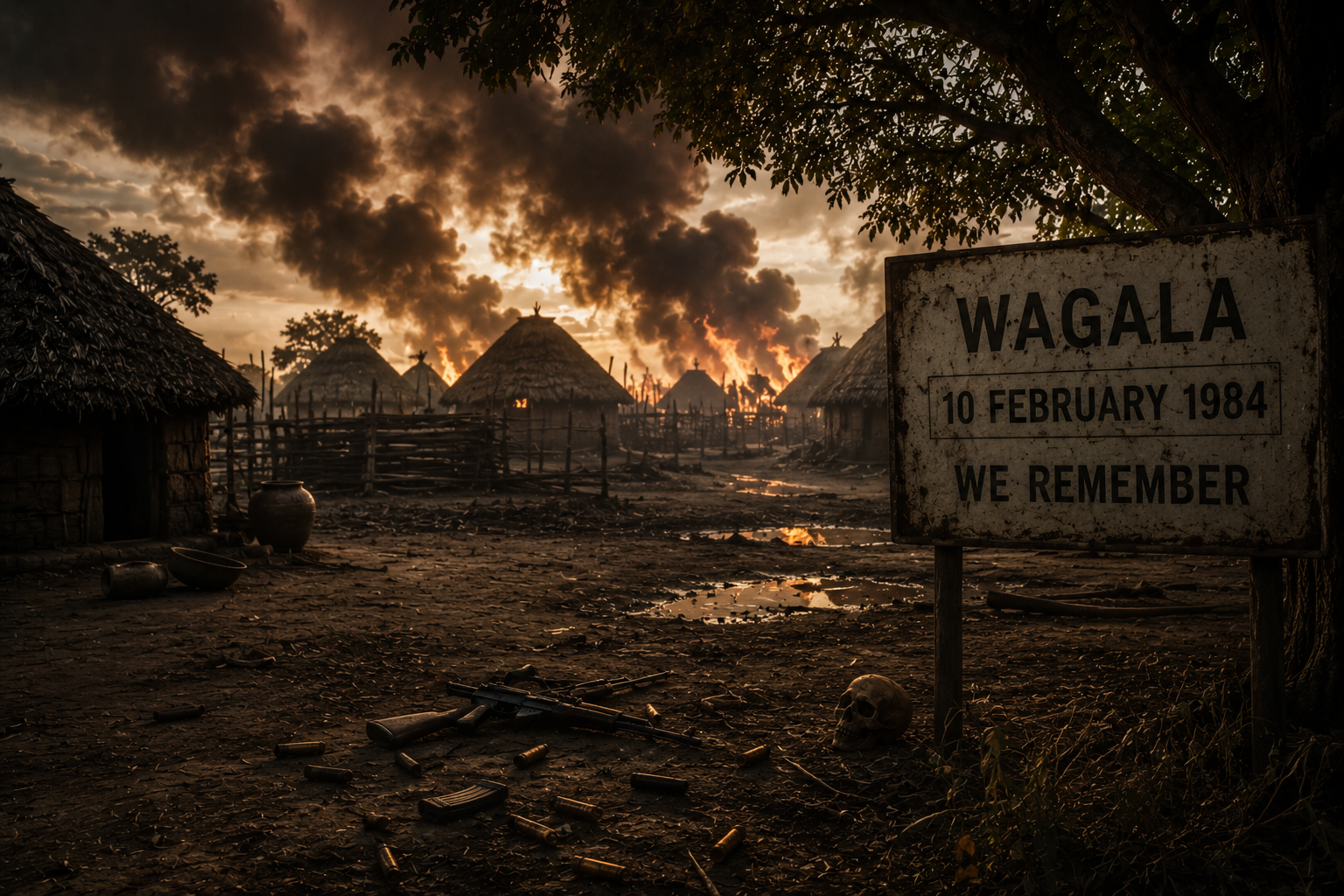
Forty-two years ago, the airstrip became a theatre of unimaginable horror. In what is now remembered as the Wagalla massacre, Kenya security forces rounded up thousands of men from the Degodia community. They were detained without food or water under the scorching sun. Many were beaten. Many were shot. Others burnt alive, beaten and tortured without food or water for four days. Thousands never returned home.
For the people of Wajir — and for Kenya as a nation — Wagalla marked a rupture. It was not merely an atrocity; it was a wound carved into the country’s conscience. Yet history is rarely only one story. Amid the brutality, humanity flickered — fragile but unextinguished.
A survivor named Alinur once spoke to me of a soldier who quietly tried to save him. In a field where cruelty seemed to reign unchecked, this unnamed Kikuyu army soldier chose restraint. While others beat detainees and ran over their backs with boots, he gave water to the thirsty and shielded the vulnerable when he could.
Abdinur remembered him vividly. “This soldier stood out,” Abdinur said. “Unlike the others, he gave people water and tried to protect me. Wagalla is gone, but I wish I could have met that Kikuyu guy. He was my ‘angel’ sent.”
Sometimes history is shaped not only by those who harm, but by those who refuse to. Ordinary citizens also risked everything. When soldiers sought to burn the house of Degodia families, an Adjuran woman stood before them and declared, “The house is mine, and I am Adjuran.” Her words were more than defiance — they were protection. The house was spared.
Those who feared rape fled toward Bulla Hodan in South C, seeking refuge wherever it could be found.
And when some survivors escaped Wagalla — naked, stripped of dignity, their bodies broken by thirst and torture — Adjuran women saw them and wept. Eight women removed their garbasaars, their shawls, and covered the men. It was a simple act. A piece of cloth placed on trembling shoulders. But in a place designed to erase dignity, it restored something sacred.
Then there was the Griftu Home Economist from upcountry who was a friend to the army major, Madogo who was responsible directly for this cruelty of Wagalla. She talked to him about dozens of her colleagues who were taken to Wagalla, till they were all released.
But then there was this on Wagalla widow who told me, “only those who sought refuge and protection in Bulla hodan and South C survived Wagalla, from our Ogaden brothers and sisters”. This is a testimony of the fact that In the aftermath of division and violence, compassion crossed clan lines.
Ahmed Dayib, the Adjuran chief of Wagalla, hid eight men in his home who escaped Wagalla field. He fed them. Sheltered them. Guided them to safety. Discovery would have meant punishment — perhaps death. But he chose compassion over fear.
There are other stories, too. There is Samuel, a young boy who lived in Wajir with his mother, Nyambura. Today they live in Nyeri, but still carry the scars of Wagalla even when they are far away…Samuel at the time about 6-7 years at Wajir primary says, “Wagalla never left me, and I never left Wagalla even when I live in Nyeri now.”
Indeed, trauma does not fade simply because years pass; it settles quietly into the body.
There is Hajji Ahmed, whom I once met in his home. He was in his golden sunset years — old bedridden and disabled, cared for tenderly by his children. Yet his memory remained sharp. He recalled arriving from Saudi Arabia through Mogadishu on a Friday morning, his goods worth thousands of shillings, his heart filled with hope. Instead, he was rounded up and taken to Wagalla. “I was robbed of my money too by the soldiers,” he says. He survived. His father did not. “I watched my father die beside me,” he told me. When he escaped, one of the eight women removed her garbasaar and wrapped it around him. “She cried when she saw me,” he said. “She removed her shawl, and I cried with her.” What language can hold such a moment?
Then there was Mama Hawa Sh. Kassim, the Badel’s and the Gosar’s families who saved fourteen Degodia men from being rounded up at her home. There was Mohamed, whose father — a respected Sheikh — was killed after he refused to undress and refused to pray on command. Mohamed was forced to carry his father’s body away. Imagine the weight of that — not only in his arms, but in his memory.
The pain of Wagalla cannot be erased. Its brutality must be acknowledged, spoken of plainly, and remembered truthfully. It stands among the gravest atrocities in Kenya’s post-independence history.
But alongside the darkness were gestures of light: shawls given freely, doors opened in secret, water shared in defiance, a soldier who chose not to strike.
History often records the violence. It documents numbers, dates, commands, and failures. What it rarely preserves are the quiet mercies — the small, dangerous acts of goodness that survive even in places designed to crush the human spirit.
Wagalla is not only a story of suffering. It is also a testament to resilience. To the stubborn endurance of compassion. To the refusal of ordinary people to surrender their humanity.
Perhaps by telling these stories — of grief and of grace — we begin not only to remember, but to heal.
This story is written by Abdullahi Irshat, as part of Wajir Diaries — the story of My People, their Pain, and My Pen.

