


|
Getting your Trinity Audio player ready...
|
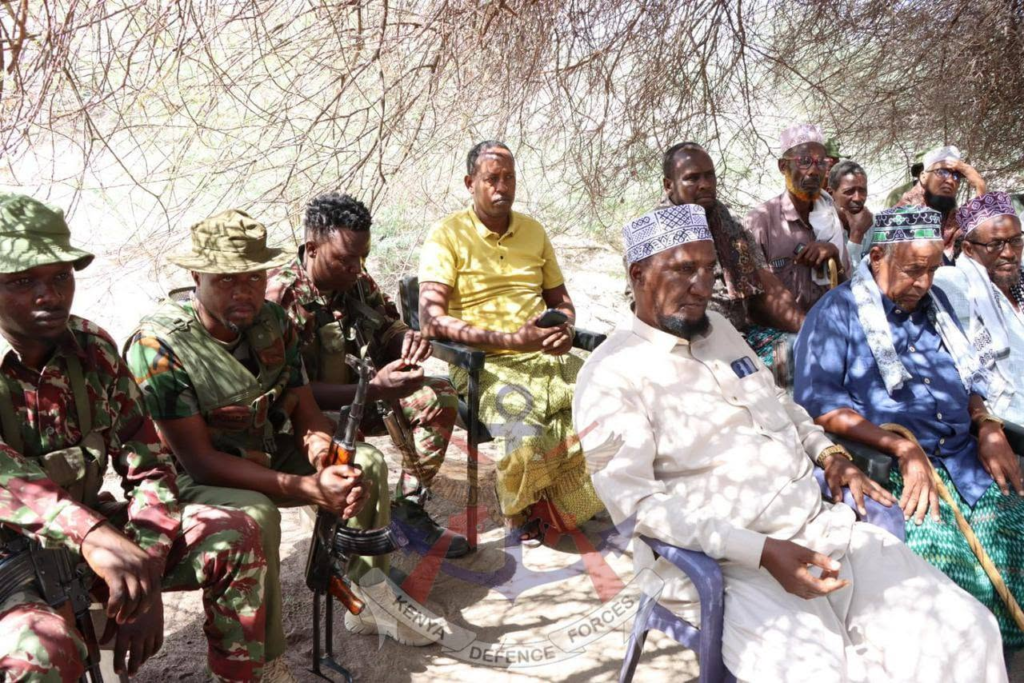
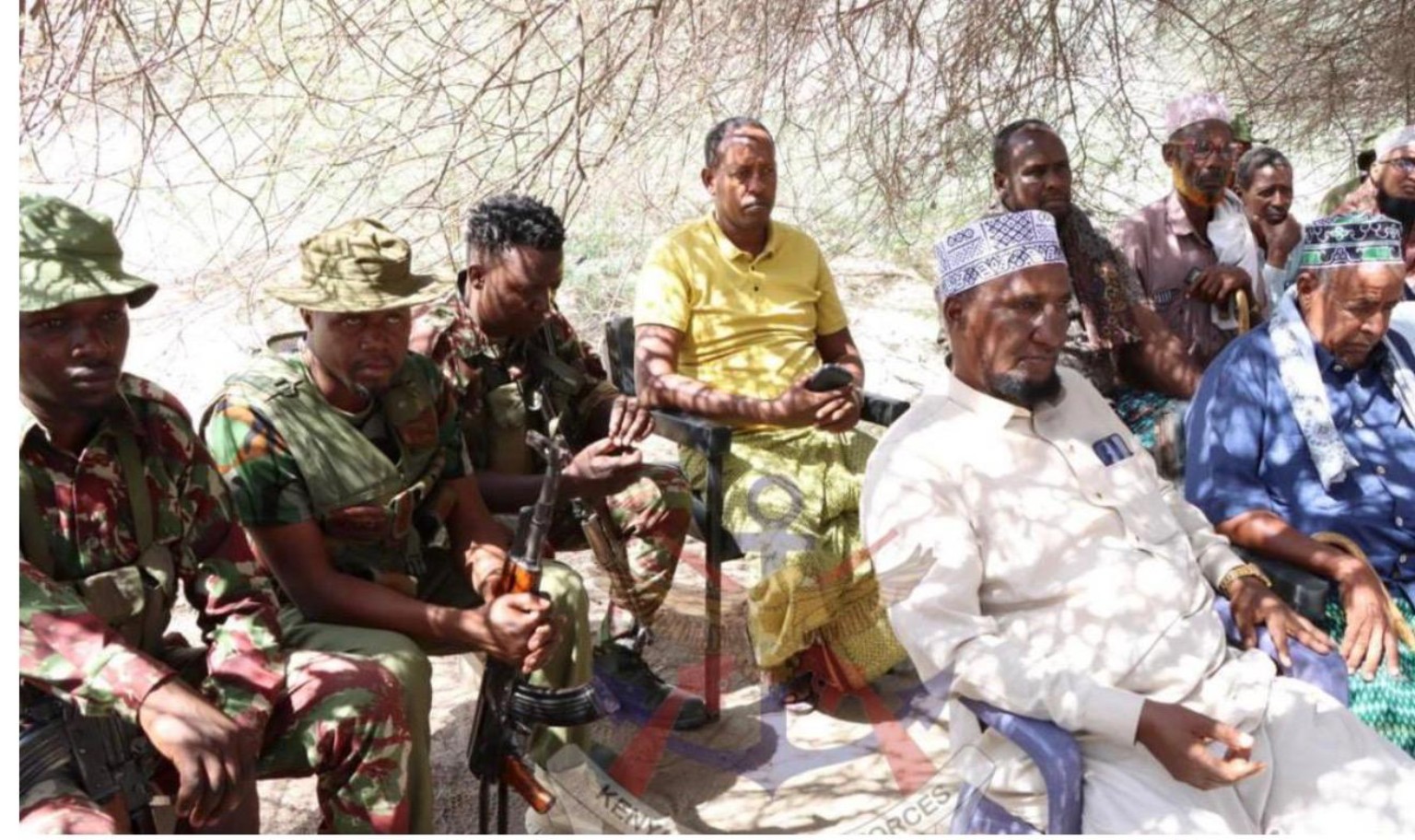
Pictured: Away from the old ways, modern Kenya Defence Forces personnel are seen engaging with the local community in Diff. Photo: Kenya Ministry of Defence.
The land surrounding Diff, near the Somali border on Kenya’s southeastern frontier, fiercely guards its stories. It refuses to let them fade into oblivion. These stories are passed down through whispered voices rather than written records, in fragments rather than files.
Among these stories, one in particular stands out: the death of Omar Shuriye Hassan, a respected elder from Diff. His brutal death, allegedly at the hands of the Kenyan army, remains etched in the memories of the people. He was mercilessly killed in March 1993.
Diff is a small town approximately 95 miles southeast of Wajir, near the Somali border. At the time, it was little more than a small hamlet, consisting of a few huts and mud-and-wattle structures. Its modest trading centre was still in its infancy, barely three or four years old.
Across the border lay Dobley, a Somali town whose proximity made Diff particularly vulnerable to the insecurity that frequently spilled across the frontier.
But Omar was not alone in this tragedy.
His brother, Abdullahi Shuriye Hassan, endured years of disability following the alleged torture inflicted upon him by the army. He remained bedridden until his death in 2000.
Elsewhere, in Leheley, another brutal episode unfolded around the same period.
Among those severely beaten was Sheikh Abdirahman Ferayare, a prominent religious leader. He sustained serious injuries, including fractured limbs and severe blows to his abdomen, resulting in significant internal bleeding.
He later died in the 2000s, with his death attributed in this account to injuries sustained during the brutal military crackdown.
Leheley, like Diff, is a small settlement situated approximately eight miles south of Wajir, along the Wajir–Nairobi road.
During these military expeditions, Kenyan security forces also reportedly killed three pastoralists in the interior bushes of Leheley. One of the victims was identified as the late Ali Nur Unshur, a resident of Leheley.
Elnur: The Village That Escaped the Brutality
At Elnur, a small water-point settlement approximately eight miles west of Wajir, the army also arrived around the same period.
However, unlike Diff and Leheley, Elnur was spared the brutality that befell the other communities.
Here, a respected community leader named Mzee Abdi Afyambe stood between the soldiers and the residents.
He approached the army lieutenant commanding the column of soldiers and engaged him in conversation.
The elderly man assured the officer, a young Kikuyu lieutenant, that there were no bandits in Elnur.
He then arranged a lunch for the soldiers, offering them two goats as a gesture of hospitality.
Remarkably, the residents were spared the beatings, torture and humiliation experienced elsewhere.
Whether it was the ingenious thinking of the old man, the better judgment of the army lieutenant, or perhaps the generosity of the now-famous “goat lunch,” we may never know.
What is certain is that the encounter ended peacefully.
The lieutenant’s wise leadership undoubtedly played a pivotal role in the outcome. Perhaps the goat lunch also played its part.
Either way, it was a win-win situation, with a positive ending for the people of Elnur.
Unfortunately, the same could not be said for Diff and Leheley.
There, the army appeared fixated on wanton torture.
The soldiers reportedly arrived with a specific mission. They had names.
At Leheley, they singled out Sheikh Ferayare.
At Diff, they came looking for the Shuriye brothers.
Whether the operations were based on credible intelligence, misinformation or mere suspicion remains unknown.
What the soldiers left behind, however, were accounts of torture and killings so cruel that they defy imagination and stand in stark contradiction to the fundamental principles of justice.
Shaletei: Another Community Under Siege
Similarly, at Shaletei, near Bulla Hodan, where internally displaced persons (IDPs) had been accommodated by the local community, the army reportedly carried out another security operation.
Residents were rounded up, intimidated and beaten under the pretext of maintaining security.
The population suffered despite having already endured the hardship of displacement.
These stories, alongside many others from the 1990s, remain painful reminders of the brutal security operations associated with the despotic Nyayo era in northern Kenya.
Indeed, allegations of brutality against civilians in northern Kenya stretch back to the country’s independence in 1963.
Other Kenyan communities have also suffered during security operations.
The people of Mount Elgon, for example, endured immense suffering during the conflict surrounding the Sabaot land rights uprising.
Similarly, pastoralist communities among the Pokot of the Great Rift Valley have experienced violent security crackdowns.
Yet the story of Diff remains particularly haunting.
March 28, 1993: The Day the Army Came to Diff
On March 28, 1993, a column of Kenyan security personnel arrived unexpectedly in Diff.
The operation involved members of the army and police.
They were searching for three men:
Omar Shuriye Hassan, Abdullahi Shuriye Hassan and Abdi Mohamed Hure.
At the time, Diff was struggling with drought and sporadic insecurity, much of it associated with instability spilling across the nearby Somali border.
However, according to local accounts, there had been no reported security incidents in Diff in the days preceding the operation.
There had been no attacks, raids or disturbances that might have explained the sudden arrival of the armed forces.
No public explanation was provided.
Nevertheless, the community immediately sensed danger.
Residents gathered in pairs and small groups, whispering anxiously among themselves.
Their worst fears soon became reality.
The soldiers ordered residents to assemble at the town centre.
The local chief, the late Ahmed Galti, was presented with three names and compelled to identify the men being sought.
Local chiefs frequently found themselves in precarious positions during such operations.
They were caught between the demands of state authority and their responsibility to protect their communities.
Refusing to cooperate with security forces could result in intimidation, dismissal or physical punishment.
Non-compliance was often interpreted as complicity.
At times, chiefs themselves were publicly humiliated before the very communities they were expected to administer.
On that fateful day, Chief Ahmed Galti faced precisely such a dilemma.
The Escape of Abdi Mohamed Hure
Fortunately, one of the three wanted men, Abdi Mohamed Hure, learned of the soldiers’ arrival before they could apprehend him.
Acting on instinct, he swiftly jumped over the acacia fencing surrounding his family’s compound and disappeared into the bush.
Within seconds, he was gone.
His quick thinking may have saved his life.
Unfortunately, Omar Shuriye Hassan and his brother Abdullahi were not so lucky.
Neither man had reason to believe that he was about to become the target of such brutality.
Omar Shuriye was a respected community elder and a local political figure.
He served as the KANU sub-location chairman, a position that gave him political visibility and influence within the community.
Perhaps, in those days, visibility itself could attract suspicion.
Why Omar and his brother were specifically targeted remains unknown.
Was it the result of misinformation?
Were they victims of false intelligence?
Or had Omar’s prominence within the community made him a target in an environment where unchecked state power could turn influence into a liability?
Neither official records nor local rumours have provided satisfactory answers.
Taken Into the Bush: The Torture of the Shuriye Brothers
Following the escape of Abdi Mohamed Hure, the soldiers seized Omar Shuriye Hassan and his brother Abdullahi from the assembled crowd.
The two men were taken into the interior bush, several miles outside the Diff settlement.
What followed was an episode of detention without trial, severe interrogation and torture, according to the community’s account.
There was no judicial process.
No charges were presented.
No opportunity was given for the men to defend themselves.
Far from public view, the brothers were subjected to savage beatings.
During the brutal ordeal, Omar reportedly suffered particularly horrific injuries, including severe mutilation of his private parts.
The violence inflicted upon the two brothers was so extreme that they were eventually abandoned in the bush, apparently left for dead.
Their captors departed.
The brothers remained behind, severely injured and helpless.
The Donkey Ride Back to Diff
Later that day, March 28, 1993, after the soldiers had left the area, members of the community began searching for the missing brothers.
They eventually found Omar and Abdullahi in the bush, both bearing the terrible injuries of their ordeal.
The men were barely able to move.
With no ambulance, no emergency medical service and no immediate institutional assistance available, the villagers had little choice but to improvise.
They placed the injured brothers on the back of a donkey and transported them back to Diff.
It was a desperate attempt to save two lives.
There was no properly equipped medical facility to receive them.
No organised emergency response.
No immediate access to the treatment their injuries required.
Once again, the community was left to absorb the consequences of state violence.
Neighbours and relatives did what they could to relieve the brothers’ suffering.
But Omar’s injuries were catastrophic.
His body had been severely battered, and his private parts mutilated.
He continued bleeding.
Four days after the torture, Omar Shuriye Hassan succumbed to his injuries.
His death marked the end of a life that had been devoted, in part, to serving his community.
Yet it was only the beginning of a painful and unanswered chapter in Diff’s history.
A Death Without Investigation or Justice
To this day, according to the account preserved by the community, Omar Shuriye Hassan’s killing has never been properly investigated.
No public inquest was conducted.
No officer was publicly identified as responsible.
No one was charged.
No one was held accountable.
In official terms, the incident barely exists.
For the family and community, however, it remains painfully real.
Omar’s brother, Abdullahi Shuriye Hassan, survived the torture, but his injuries permanently altered the course of his life.
He suffered severe physical disability and remained bedridden for years.
He eventually died in 2000, a broken and disabled man.
His death marked another chapter in Kenya’s painful history of alleged torture without due process and deaths without answers.
Another casualty linked to an operation that, according to the community, the state has never formally acknowledged.
But Diff was not alone.
Leheley: The Public Humiliation of Sheikh Ferayare
In Leheley, another respected community figure suffered a similarly brutal fate.
Sheikh Abdirahman Ferayare was a tall, heavily built and widely respected religious elder.
He was known for his courage, outspoken nature and deep religious conviction.
A fearless man, the Sheikh frequently criticised injustices committed by local administrators and security personnel.
He was particularly vocal about the mistreatment of civilians and the excesses of government authority.
His willingness to speak openly made him an influential figure within the community.
It may also have made him a target.
On the day the army arrived in Leheley, soldiers ordered residents to gather at the town centre.
Several men were beaten.
Women, schoolchildren and individuals carrying work identification documents were reportedly released.
The Sheikh, however, was singled out from a group of madrasa teachers.
He was paraded before the assembled residents and subjected to severe beatings.
The soldiers reportedly dragged his body along the ground while he was dressed in his Islamic religious garment, the Qhamis.
It was an act of physical violence accompanied by deliberate public humiliation.
The intention appeared to extend beyond punishing one individual.
It was a warning to the entire community.
There is an old principle often employed by oppressive authorities: punish the leader publicly, and the population will learn to submit.
The Somalis have a saying for this:
“Diibiga gowraa, weesha aku’ala’qathatee.”
In essence, it means:
Slaughter the male calf so that the female calf learns a lesson.
The message is simple and chilling.
Humiliate or punish a respected community leader, and others will become fearful of challenging authority.
This was the apparent purpose of the treatment inflicted upon Sheikh Ferayare.
The Sheikh Who Refused to Remain Silent
Sheikh Ferayare had long been regarded as a fearless speaker of uncomfortable truths.
He had previously spoken out forcefully following reports that pages of the Holy Quran had been found desecrated and soiled in a toilet in Wajir.
The identity of the person responsible for the desecration remained unknown.
Nevertheless, the Sheikh publicly condemned the incident and demanded that it be taken seriously.
His outspoken response attracted considerable attention.
Some members of the community suspected that his subsequent mistreatment by the army was connected to his public criticism and agitation.
Whether this suspicion was correct remains unknown.
What is remembered is that the Sheikh was singled out, beaten and humiliated in front of his community.
He sustained severe injuries, including fractures and abdominal trauma.
According to the account, those injuries contributed to his prolonged suffering and eventual death in the 2000s.
His story, like that of Omar Shuriye, remains part of the painful collective memory of Wajir.
The Nyayo Era and the Culture of Impunity
Returning to the tragedy at Diff, more than three decades have passed since Omar Shuriye Hassan was taken into the bush and tortured.
Yet his killing remains an unacknowledged chapter in Kenya’s official historical record.
The events unfolded during the early 1990s, under the authoritarian government of President Daniel arap Moi.
The period, widely known as the Nyayo era, was marked by allegations of political repression, arbitrary detention, torture and abuses of state power.
In northern Kenya, these practices were compounded by decades of marginalisation and harsh security policies.
Communities in the region had long endured the consequences of emergency-era legislation and security operations conducted with limited public scrutiny.
Of particular significance was the Indemnity Act, which became associated with the denial of legal remedies for abuses committed during certain security operations in northern Kenya.
The legislation protected specified actions by state officials from legal proceedings, contributing to a climate in which victims and their families faced serious obstacles in seeking accountability.
For many residents of the region, the Act symbolised a system that allowed security personnel to operate with impunity.
The consequences were devastating.
Allegations of unlawful killings, rape, torture, intimidation and destruction of property became part of the region’s historical experience.
Victims were frequently left without meaningful avenues for justice.
Families were left to bury their dead.
Communities were left to remember.
And the state often remained silent.
When Violence Goes Undocumented
The case of Omar Shuriye Hassan raises profound questions about the nature of the Kenyan state during that period and its relationship with communities in marginalised regions.
When violence goes undocumented, it becomes easier to deny.
When abuses are not investigated, they become easier to repeat.
And when communities are left to carry painful memories without official recognition, the distance between citizens and the state grows wider.
Omar Shuriye’s story belongs to a broader history of marginalisation in northeastern Kenya.
It is connected to the legacy of emergency-era security policies and the conduct of a security apparatus that, for decades, operated with limited transparency and accountability in peripheral regions.
For the people of Diff, Leheley, Shaletei and other affected communities, these events are not merely distant historical episodes.
They are personal memories.
They are stories of fathers, brothers, elders, religious leaders and neighbours.
They are accounts of people whose lives were interrupted or destroyed.
Some survived with permanent disabilities.
Others never returned home.
And many died without ever receiving justice.
Remembering the Dead Is an Act of Defiance
In this context, remembering those who were unjustly killed becomes more than an act of mourning.
It becomes an act of defiance against historical silence.
It is a declaration that those who died did not die in vain.
Their memories deserve preservation.
Their stories deserve to be told.
Their names deserve a place in the national historical record.
For the communities of northeastern Kenya, remembering loved ones allegedly killed by state security forces has been a painful odyssey stretching back to the 1960s.
Generation after generation has inherited these memories.
Some are preserved through oral accounts.
Others survive in family conversations, whispered recollections and stories told by elders.
Many remain undocumented.
Yet the absence of official records does not erase the pain experienced by those who lived through these events.
Nor does it diminish the importance of seeking the truth.
Justice is not only about the present or the future.
Justice is also about the past.
It requires acknowledging what happened, recognising those who suffered and confronting the circumstances that allowed such abuses to occur.
Who Killed Omar Shuriye Hassan?
In Diff, the land of my people, the questions surrounding Omar Shuriye Hassan’s death have never disappeared.
Who killed Omar Shuriye?
Who ordered his arrest?
Who authorised the operation?
Who allowed the torture to take place?
And why were he and his brother targeted?
More than thirty-three years have passed since that fateful day of March 28, 1993.
Yet there is still no publicly established answer.
No official accountability.
No justice.
For the family of Omar Shuriye Hassan and the people of Diff, the wounds of that day remain open.
The passing of time has not erased the memories.
The silence of official institutions has not settled the questions.
And the absence of justice has not brought closure.
Until the circumstances surrounding Omar Shuriye Hassan’s death are fully established, the story of Diff remains unfinished.
It continues to wait.
Waiting for truth.
Waiting for accountability.
Waiting for justice for Omar Shuriye Hassan.
Written by Abdullahi Irshat Sheikh
Part of The Wajir Diaries: The History of My People, Their Pain, and My Pen.
