

|
Getting your Trinity Audio player ready...
|
Of course, I remember those memorable days of the Nyayo dictatorship and the introduction of the dreaded regime of screening exercises.
I vividly recall an incident involving the late Abass Hassan Qaasay, who had at one time served as a KANU youth winger. On one occasion, after alighting from a Garissa Express bus from Nairobi in front of Kulan Hotel, I was confronted by Abass, accompanied by two police officers. They accused me of being a foreigner and demanded that I accompany them to the police station without offering any reasonable explanation.
Apparently, I had been mistaken for a Milan Dufte.
I gave them short shrift and told them to get lost.
Mama Fathuma M. Mire, however, was not going to let the matter pass. She gave the late Abass a thorough tongue-lashing, telling him that if he did not know my family, then he was himself a nobody and a Milan Dufte in Wajir.
Then, as though by some miracle, Bader Saleh Ilkayare appeared. He was apparently the commandant of the youth wingers. He immediately apologised profusely to Mama Fathuma, kissed me on both cheeks, picked up my luggage and escorted me home.
We were immediate neighbours.
Upon arriving at our home, he went on to greet my mother, kissing her knees and apologising profusely to my parents for what had transpired. To my surprise, Abass also eventually came home to apologise.
It was that day that I learnt something about the longstanding friendships between the Qaasay, Elmi and Lord families.
That was the Wajir I grew up in and fondly remember.
Maalim Abass and Sheikh Abdi Bardad were practically uncles to us. They treated us with the warmth, familiarity and affection that one would expect from family. Relationships transcended political affiliations, misunderstandings and occasional disagreements. There was a deeply rooted sense of community, mutual recognition and belonging.
Unfortunately, we belong to one of the last generations tenaciously holding on to those formative aspects of Wajir’s history, the days when Wajir was regarded as the firstborn, or curad, of our region and occupied an undisputed position of leadership.
Yes, I cherish those days immensely.
I understand that time moves on and that change is inevitable. Every generation must find its own identity, establish its own priorities and shape the society it inherits.
But kindly allow us the space to reminisce about the fond memories of our youth and the Wajir that shaped us.
Our recollections are not declarations of hostility towards the present generation. They are not attempts to reclaim authority, challenge anyone’s position or diminish the achievements of those who came after us.
We are not a threat.
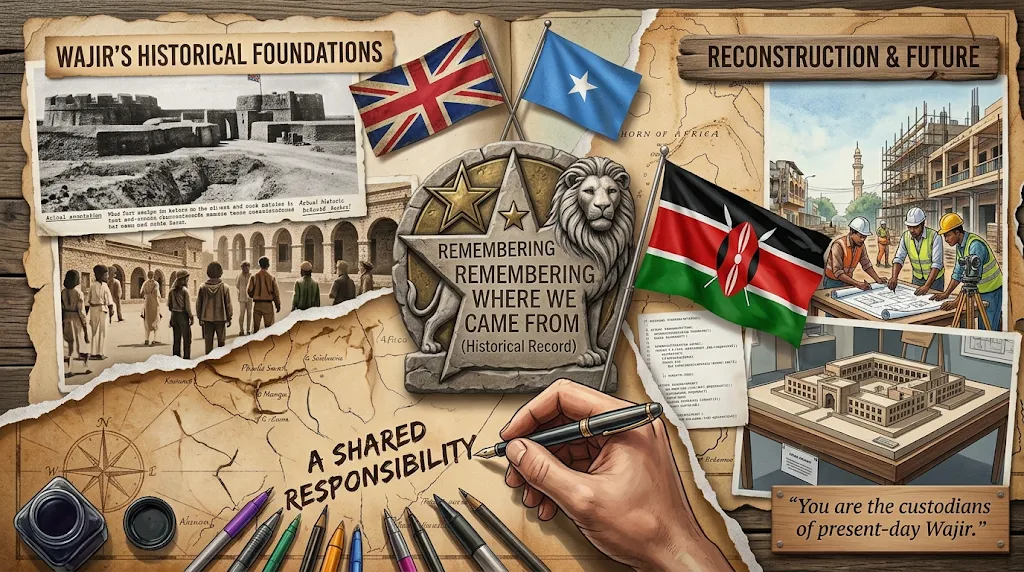
You are the custodians of present-day Wajir. You hold the responsibility and authority to shape its future as you deem appropriate.
But we, too, have a responsibility: to preserve the memories, relationships, values and experiences that shaped the Wajir we knew.
We will always remain the guardians of the flame that gave birth to the Wajir of today.
And perhaps that is the greatest privilege of having lived through those times: to remember where we came from, appreciate what we have become and ensure that the stories of our generation are never lost.
We may have moved on with time, but we have not forgotten the Wajir that formed us.
